Bus, car, coach tour or train — real 2026 prices, honest timings, and the hour that catches people out.
 By Eugene · updated 25 September 2026 · 14 min read
You can do Chichén Itzá from Cancún in a day. About three hours each way, a wonder of the world in the middle, back in time for dinner where you had breakfast.
The question is not whether it works. It is what time you arrive — because that single decision changes the temperature, the crowd, the photographs and whether you enjoy the day or endure it.
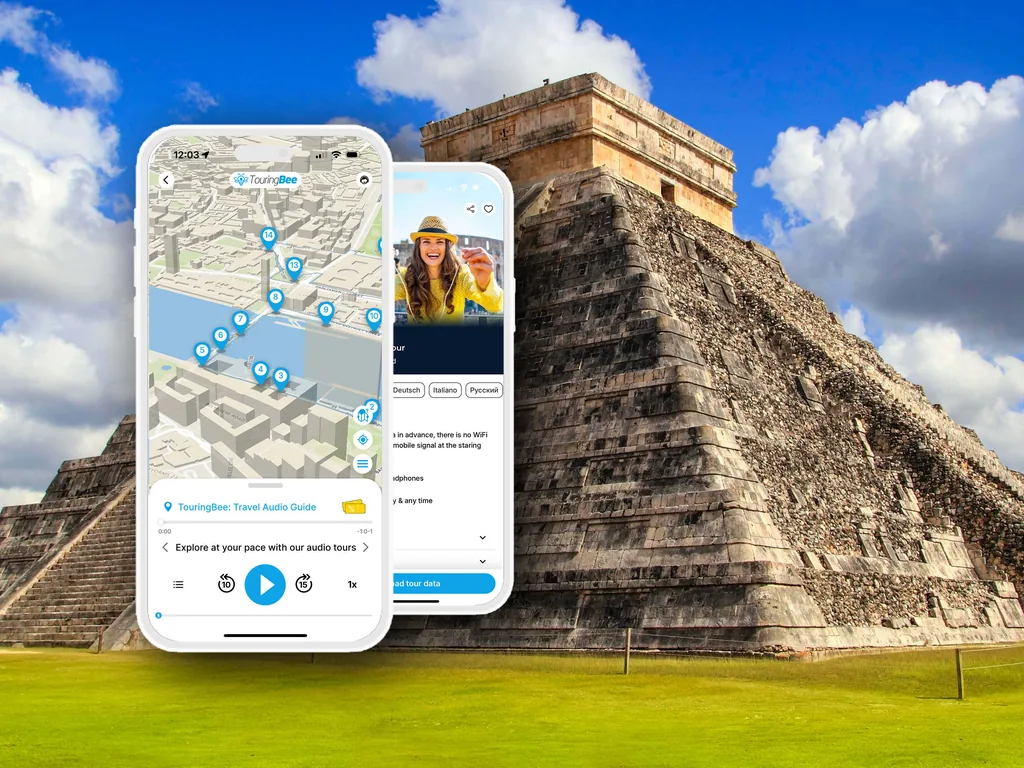
If you are going independently, download the audio guide before you leave. It walks you through the archaeological zone at your own pace: 16 stops, around 90 minutes, with a GPS map and audio that work fully offline. Useful above all if you have made the effort to arrive at opening and would rather not stand around waiting for a group guide.
Chichén Itzá audio guide — €9.99 →
And there is a detail the brochures skip. Yucatán is an hour behind Quintana Roo. Your phone will quietly move itself back somewhere past Nuevo Xcan. It is an easy difference to miss — especially when you are working out how to get home.
Prices and timetables checked on 24 September 2026.
Some links on this page are affiliate links (GetYourGuide, Tiqets, Booking.com). If you book through them we may earn a small commission, at no extra cost to you. It never affects what we recommend.
About 200 km — sources put it between 196 and 205 km depending on whether they measure from the hotel zone or downtown. The route is the 180D, a straight, dull, well-surfaced toll road through flat scrub. There is almost nothing to look at and almost nothing to hit.
Routing apps say 2 h 11 m. Ignore them. Add the crawl out of the hotel zone, one toll plaza where the card reader is thinking about it, and the last stretch through Pisté village, and the honest figure is about three hours each way — two and a half at the very best.
There is a free alternative, the 180 libre, which runs through Nuevo Xcan, Chemax, Valladolid and Pisté. It is noticeably slower: it threads through towns and villages, with lower speed limits and frequent topes — speed bumps that are rarely signed in advance. Estimates of what that costs you vary a lot, from half an hour each way to twice the driving time.
If an early arrival is the point of your day, the toll saving is rarely worth the time you give up. The route does earn its place if you want to stop in Valladolid.
Quintana Roo, where Cancún sits, is on UTC−5 and does not change all year. Yucatán, where Chichén Itzá sits, is on UTC−6.
Chichén Itzá runs one hour behind your hotel.
Two consequences, and both bite.
Leave Cancún at 08:00 and you reach the gate around 10:10 by your hotel's clock — but it is 09:10 there. You gained an hour. Good.
Now the bad half. The site closes at 17:00 local, which is 18:00 Cancún time. Sounds generous.
But the last tickets go at 16:00 local — 17:00 to you. Keep Cancún time in your head all day and it is easy to get the last entry wrong by exactly an hour.
The fix is simple and worth doing before you set off: let your phone update, and then think in local time for the whole day. If you are on a tour, the driver handles it. If you are driving, your phone will usually switch by itself — the clock on the dashboard will stay on Cancún time.
A proposal to move Yucatán onto Cancún's time has been sitting in the state congress since 2025 and has not passed. As of 2026 the hour still applies.
The default, and for a lot of people the right answer. A coach collects you between 06:30 and 08:00 from your hotel, spends an hour gathering other passengers, drives two and a half hours, and puts you at the archaeological zone somewhere between 10:30 and 12:00. Entry is arranged, a guide walks you round, and the afternoon usually adds a cenote, a buffet and twenty photogenic minutes in Valladolid.
What you are buying is that you do not have to think. No driving on the wrong side of an unfamiliar country, no toll plazas, no working out where to park.
What you give up is the morning. You will arrive precisely when the zone fills and the heat peaks, and you will get roughly two hours on the ground during the hottest, busiest part of the day. Door to door the whole thing runs 12 to 14 hours.
Watch the price. A typical listing shows around US$57 per person — and then admission, US$44, is collected separately on the day. The real number is about US$101, which is the top of the budget band, not the bottom. Early-access tours that get you in near opening exist and run US$140–200, with a pick-up around 04:30.
Compare Chichén Itzá tours from Cancún on GetYourGuide → — filter for early departures and check whether admission is included before you compare prices.
The simplest way to get yourself to the gate at opening under your own steam — and the main reason to consider it.
An economy car from Cancún airport advertises at almost nothing — US$5 a day on the aggregators. That is not the final price. Mexican law requires third-party liability cover, it is usually left out of the online quote, and it is added at the counter at US$20–30 a day. Those mandatory fees add substantially to what you actually pay at the desk.
The honest all-in figure for an economy car is US$40–60 a day. Budget for that and the counter holds no surprises.
On top: tolls of roughly 500 MXN each way, fuel of about 700–790 MXN for the round trip at current Magna prices, and 50–120 MXN to park. The 180D went up 4.6% in April 2026, so the widely-quoted blog figures of 200–300 MXN are years stale.
The 180D toll booths take cash pesos only. No cards, no app, no exceptions — and this is the kind of thing people find out at the barrier, with no way through.
Fill up before you join the toll road. Exits and petrol stations on it are sparse, and the first convenient ones are already down by Valladolid.
The scheme that works is toll road out, free road back. In the morning you are buying speed, and it puts you at the gate for opening; on the way home there is nothing to rush for, and the free road delivers you to lunch in Valladolid all by itself.
Split between three or four people that is comfortably the cheapest fast way to do it, and the only one where the clock is yours.
Compare car hire in Cancún → — check the quote includes Mexican third-party liability, not just collision.
Cheap, comfortable, air-conditioned, and built on a knife edge.
From Terminal ADO Cancún Centro (Av. Tulum × Av. Uxmal, downtown — there is no direct service from the airport) the useful departure is 08:45, arriving around 11:10. The fare runs US$29–30 one way, less if you book online in advance. The bus drops you at the visitor centre, not in the village.
Now the part that strands people. There are effectively two return departures, and the usable one leaves around 16:00 — some sources say 16:30, live inventory says 16:00, and the honest advice is to treat 16:00 as the truth and be early.
Miss it and there is no later bus to Cancún. Your fallback is a colectivo or taxi the 2.6 km to Pisté, a bus to Valladolid, and an onward connection — an evening you did not plan.
Book 24–48 hours ahead; seats sell out on cruise-ship days. If an online payment with a foreign card does not go through, you can buy at the counter, in the app, or at a local sales point such as an OXXO.
The bus gives you about five hours on site, which is plenty. It just gives them to you starting at 11:10, in the heat, in the crowd.
The station opened in 2024 and it is real — but check what it actually does before you build a day around it.
It sits 3 km from the entrance, near Pisté, with a coordinated shuttle that takes about 20 minutes and costs around 50–55 MXN.
The trouble is the timetable: the westbound train calls at Chichén Itzá around 10:46 and the eastbound around 17:47, both local. Against a site that stops selling tickets at 16:00, that is a long wait at the wrong end of the day, and Cancún-side fares price out well above the bus.
As a way to break a Mérida–Cancún journey, it is excellent. For a day return from Cancún, the timetable is simply less convenient than ADO's: you arrive late, and then you wait a long time for the train back. Fares are dynamic, so check on the day rather than trusting any figure you read — including this one.
Short answer: yes, and this is one of the calmest roads in Mexico. Longer answer: the dangerous thing here is not Mexico. It is the driving.
Yucatán is the most peaceful state in the country — ninth year running on the Mexico Peace Index. In 2025 the entire state recorded 33 homicides: 1.03 per 100,000 residents, against a Mexican average of 12.9–17.5, more than ten times lower. The US State Department keeps Yucatán at Level 1, "exercise normal precautions" — the lowest rating there is, and only two Mexican states hold it, the other being Campeche. The same advisory names Chichén Itzá outright: US government employees may travel there without restriction. Britain's FCDO and Canada's foreign ministry place no restrictions on Yucatán or Quintana Roo either.
The carjackings and highway robberies you may have read about are pinned by both of those governments to other parts of the country — the Pacific coast and the northern border. On the Cancún–Chichén Itzá corridor there are no such reports. That is an absence of reports rather than a proven zero, and it is worth saying plainly: the fear travels here from news about a different Mexico.
Now the honest part. In 2025, 276 people died on Yucatán's roads — eight times the homicide count. The thing that can spoil this day is driving, not crime. Which makes your real risks for the day these five.
The parking touts. Two to five kilometres short of the archaeological zone, men in uniform-style shirts stand on the verge waving "STOP" signs and try to wave you off into their own car park. It looks like a police checkpoint, and that is exactly what makes it work. It is not the police. Do not stop, keep going to the end of the road, to the official municipal car park: 50 metres from the ticket windows, on camera, watched by state police, and a fixed 50–120 MXN for the whole day.
The dark. American, Canadian and local advice all land in the same place: between towns, drive in daylight only. There is no lighting on the highway, animals and people walk the verges, and by evening you have been on your feet for eight hours. Leave the zone early enough to be home in the light — and that is the real argument for heading off in the middle of the day rather than sitting it out until closing.
Topes on the free road. The speed bumps through the villages are often unmarked and blend straight into the tarmac. The regulations say they have to be signed; in practice it is luck. The toll road has none at all — one more reason to take the 180D in the morning.
Quintana Roo's traffic police. The state itself admitted its transit police were the most corrupt force in the country, and from late 2025 it is abolishing the post altogether: fines move to automatic cameras, where there is nobody to negotiate with. The reform runs to 2027 and cases still happen — in June 2026 an officer was filmed in Cancún demanding US$630 from American tourists. If you are pulled over: do not hand over money and do not hand over your passport, ask for a copy of the ticket — it is paid later — and ask the officer for identification. A genuine stop ends with a paper receipt, not cash on the roadside. In Yucatán tourists barely encounter this at all.
Petrol stations. Short measure is a known story: in October 2025 Profeco shut down ten stations in Quintana Roo for delivering less than a full litre. Get out of the car, check the pump has been zeroed, and say the amount out loud. There is no self-service in Mexico, and it is normal to leave the attendant the small change.
All of which comes down to four decisions: the toll road, daylight only, liability cover already inside the rental price, and cash pesos for the toll and the car park. Plus one number: 078, the free line for the Ángeles Verdes — the Green Angels, the tourism ministry's roadside assistance. Labour and towing are free; you pay only for parts.
| Coach tour | Your own car | ADO bus | |
|---|---|---|---|
| Transport, 2 people | included | ~1,000 MXN toll + ~750 fuel + 100 parking | ~2,200 MXN return |
| Car hire | — | US$40–60/day all-in | — |
| Entry, 2 adults | often extra, US$44 pp | 1,394 MXN | 1,394 MXN |
| Arrival | 10:30–12:00 | 08:00 if you want | ~11:10 |
| Time on site | ~2 h, fixed | as long as you like | ~5 h |
| Door to door | 12–14 h | ~10 h | ~13 h |
| Cenote | usually included | 60–200 MXN, your choice | hard to fit |
| Best for | people who would rather not handle the logistics | people who want an early entry and a flexible day | solo travellers watching the budget |
The arithmetic is closer than people assume. Two people driving themselves spend roughly 1,850 MXN on the road plus the car, against 110–150 € for two on a standard coach with lunch included.
The real difference is not the money. It is what time you walk in.
Going independently?
Nobody includes a live guide in the price of the road. The TouringBee audio guide covers 16 stops in about 90 minutes and works fully offline. Arrive at opening and you can start straight away, without waiting for a group.
Open the audio guide →If you are driving. Leave Cancún 05:30. Reach the gate 07:45 local, before it opens. Go in with the first arrivals: in the first minutes after opening there are usually far fewer people around than there will be once the daytime coaches pull in. Out by 11:30 as they unload. Cenote until 13:00, lunch in Pisté or Valladolid, home by 16:00 Cancún time. Ten hours door to door, and you saw the archaeological zone before the main daytime flow.
If you are on a coach. Pick-up 07:00, on site 11:00, two guided hours in the heat, cenote and buffet, Valladolid photo stop, back at the hotel around 20:00. Thirteen hours, and nothing for you to organise.
If you are taking the bus. ADO 08:45, arrive 11:10. Buy your ticket, start at the far end of the site where the groups have not reached yet, work backwards. Shade break 13:00–13:45. Back at the bus stand by 15:30 for the 16:00 departure — and genuinely by 15:30, not 15:55. In Cancún by 19:00.
This changed in 2026. If you have read older instructions about two separate ticket windows, they no longer apply.
Chichén Itzá used to charge two separate fees at two separate windows — the federal INAH fee and the Yucatán state fee. That system is gone. The Boleto Único replaced it in spring 2026: one ticket, one payment, one window, inside the new CATVI visitor centre that opened in March.
The total for a foreign adult is unchanged at 697 MXN (the INAH portion is 105, the state portion 592 — they are just no longer collected separately). Foreign children 3–12 pay around 105 MXN; under 3 free. Mexican nationals pay about 310 MXN with ID. Sunday free entry applies to Mexican nationals and residents with Mexican ID, not to foreign tourists.
Two practical notes. Card payment is available, but it is worth carrying pesos in case of a problem with the terminal. And the new visitor centre routes you through a museum before you reach the monuments, which adds real time to the visit; allow for it if your return bus is fixed.
Buy entry tickets in advance →
The northern zone has almost no shade and you will walk at least 4 km. Average daily highs sit at 33–35 °C from March to September, and the UV index reaches 11 for five months of the year. That is not a detail — it is the thing that ends people's visits early.
Toilets are at the entrance and the visitor centre — there are none inside the site, so use them before you walk in. Lockers are available after security for around 40 MXN.
This is where driving pays for itself a second time.
Ik Kil is the famous one: 3 km from the ruins, a near-perfect circular sinkhole with vines down the walls, and the cenote your coach tour will take you to. Entry is 180–200 MXN. It is busy in the middle of the day for the same reason the ruins are: it is the standard stop on the group-tour circuit. Come at opening or later in the afternoon and it is a noticeably calmer place.
Yokdzonot, 7 km away, is the quieter alternative, run by a local women's co-operative. Entry is 60 MXN, and the money stays in the village.
Choo-Ha, 45 km towards Cobá, is an underground cave cenote at 80 MXN — well off the main tourist circuit, and convenient as a stop on the drive back.
A cenote fits comfortably into a self-driven day and barely fits into a bus day. On a coach tour it is already decided for you.
Chichén Itzá was closed for almost two weeks in May 2026 — 18 May to 1 June — over a local dispute around the new visitor centre. It was settled by agreement, but similar disputes have flared before.
So check the status on INAH's official channels the morning you travel. Nobody wants to discover this after a three-hour drive.
You spent the effort and the money to reach Chichén Itzá ahead of the tour buses. Standing around waiting for a tour after that makes no sense.
If you are at the gate at 08:00, there is no group to wait for. The TouringBee audio walk covers Chichén Itzá in 16 stops and about 90 minutes, in walking order: from the entrance to El Castillo and back. Map, GPS and audio all work offline, and you start each recording yourself when you reach the monument, so your eyes stay on the carvings rather than the screen.
Eight languages, iOS and Android, €9.99 once and a year of access. Offline is not a small thing here: the zone is large, and you will not be downloading anything on the spot.
The pace is yours. You can sit in the shade for twenty minutes without falling behind anyone, and pick the story back up in the same place.
It cannot answer a question — that is what a human guide is for. If asking questions as you go matters to you, hire a licensed guide at the entrance. If an early start, your own pace and the price matter more, the audio guide is built for exactly that.
About 200 km via the 180D toll road. Routing apps say 2 h 11 m; allow two and a half to three hours each way in practice.
Yes — it works as a day trip: the drive is around 2.5–3 hours each way. The most comfortable version is to be there for opening; by 11:00 it is noticeably hotter and busier.
The ADO bus, at roughly 1,100 MXN return per person, plus 697 MXN entry. Driving is cheaper per head once you are three or four people.
05:30 if you are driving and want the gate at opening. Standard coach tours collect between 06:30 and 08:00 and reach the site around 11:00.
Yes. Yucatán is one hour behind Quintana Roo, all year. The site closes at 17:00 local and last tickets are 16:00 local — an hour earlier than your hotel clock suggests.
You can, but in 2026 it does not work well as a day return: the station is 3 km from the gate, the westbound train calls around 10:46 and the eastbound around 17:47, and Cancún-side fares are well above the bus.
697 MXN for a foreign adult, paid as a single ticket at one window since the Boleto Único replaced the old two-queue system in spring 2026. Children 3–12 pay around 105 MXN.
Yes. Yucatán is Mexico's most peaceful state and one of only two at Level 1, the lowest rating in the US State Department's advisory — which names Chichén Itzá directly. The real risks on this route are mundane: do not drive after dark, do not stop for the touts waving "STOP" signs a few kilometres before the entrance, carry cash pesos for the toll road, and watch the pump has been zeroed when you fill up.
Easily if you are driving — Ik Kil is 3 km away, Yokdzonot 7 km and quieter. On the ADO bus it is a tight squeeze against the 16:00 return. On a coach tour it is usually included.
The pyramid, the ball court, the well and the observatory — explained where you're standing, at your own pace.
Get the Audio Tour — from €9.99