The entrance moved in 2026 and almost every route description still describes the old one. Order, distances, hours and honest timings.
 By Eugene · updated 1 October 2026 · 13 min read
Chichén Itzá can be walked without a guide, and most people do. There is no compulsory tour, no fixed circuit and nobody checking whether you know what you are looking at.
The catch is that the walk itself changed in 2026, and almost every route description online — including guides updated this year — still describes the old one.
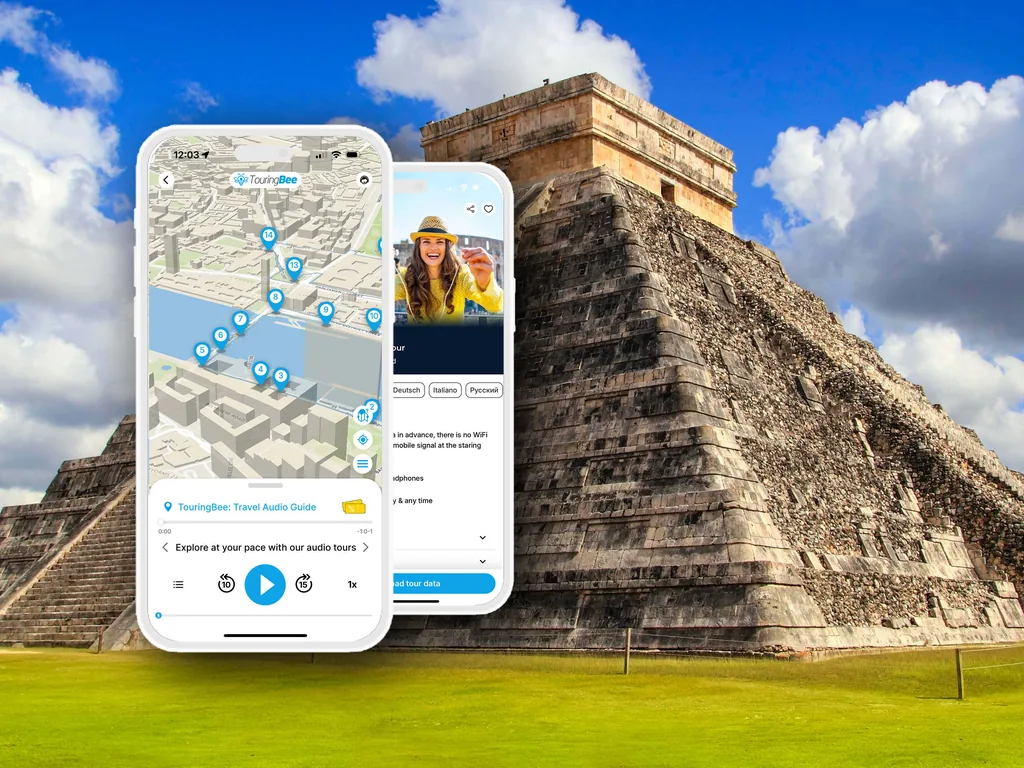
If you would rather not stand in front of the Temple of the Warriors wondering what those two hundred carved columns were for, the TouringBee audio walk covers the archaeological zone in 16 stops and about 90 minutes, at whatever pace you keep. Map, GPS and narration all work offline, and you start each recording yourself when you arrive at the monument.
Chichén Itzá audio guide — €9.99 →
Everything below assumes the 2026 entrance, not the one in your guidebook.
Details checked on 30 September 2026.
Some links on this page are affiliate links (GetYourGuide, Tiqets). If you book through them we may earn a small commission, at no extra cost to you. It never affects what we recommend.
For decades you entered from the west, through the old Parador Turístico, and arrived almost immediately at El Castillo. The Sacred Cenote was a there-and-back detour from the pyramid, or skipped.
That is no longer how it works.
The new CATVI visitor centre stands roughly 900 metres north of El Castillo, on federal highway 180. Yucatán's tourism secretary, Darío Flota Ocampo, has described the new sequence plainly: the cenote first, then the Castillo. You now reach the Sacred Cenote before you reach the pyramid.
The old western Parador Turístico was taken out of service in June 2026. There is one entrance now, through CATVI, and INAH has given no indication it plans to change that arrangement back.
Be careful how much you build on this, because the detail is thin. Not documented anywhere we can find: the exact line the internal path takes from CATVI to the monuments, its surface, how much of it is shaded, whether the Sacred Cenote is still a dead-end spur off the causeway or now sits on the way in, and whether any shuttle runs.
Official distance figures do not agree with each other either:
So plan for something between 800 m and 2 km each way, on foot, in the open. No official walking time has been published. Thirty to sixty minutes for the round trip, on top of your time among the monuments, is a sane allowance rather than a measured one.
If the whole archaeological zone were one architectural period, the order you walked it in would be a matter of taste. It is not, and that is the one solid reason to think about sequence.
The core covers at least 5 km². INAH counts six groups of monuments: the Gran Nivelación (the main plaza), the Grupo de las Mil Columnas, the Grupo del Osario, the Grupo de la Casa Colorada, the Grupo de Las Monjas and Chichén Viejo.
For a walking visit, they collapse into two:
The north is Toltec. El Castillo, the Great Ball Court, the Tzompantli, the Temple of the Warriors, the Thousand Columns. Broad plazas, colonnades, feathered serpents, military iconography. This is the Chichén Itzá of the postcards, and the part every group is taken to.
The south is older and Maya, in the Puuc style. El Caracol, Las Monjas, La Iglesia, the Red House. Smaller, denser, heavily ornamented, laid out without the parade-ground scale of the north.
The architectural periods are sorted geographically. Walk the site as one loop and you also walk it roughly in chronological reverse. That is the whole argument for having an order at all, and it is why "just wander" leaves most people with a strong memory of one pyramid and a vague blur around it.
Distances between the northern monuments are short. El Castillo to the Great Ball Court is about 150 m; to the Temple of the Warriors about 120 m. Sacbe No. 1, the ancient paved causeway from El Castillo to the Sacred Cenote, is 270 m long and averages 9 m wide — some sources give 300 m.
Nobody has published data on how groups distribute themselves inside the zone once they are through the gate. What is documented is the entrance: INAH's own load figures, reported via Proceso, put the pressure on the entry between 10:00 and 14:00. Coaches begin arriving around 10:00–11:00 and groups start leaving between 14:00 and 15:00. In 2024 the site took 2.2 million visitors.
So what follows is reasoning from the entrance data, not a documented crowd map. Treat it as a working plan.
If you arrive at opening. You have a clear run before the coaches, and the main plaza is what they all head for. Spend the first hour on the Gran Nivelación — El Castillo, the ball court, the platforms, the Temple of the Warriors, the colonnades — because that is the hour nobody else is there. Then, as the buses unload, move south into the Puuc group, where the group circuits spend least time.
If you arrive mid-morning, between 10:00 and noon. You are arriving inside the peak. Inverting the plan costs you nothing: go south first — El Caracol, Las Monjas, the Casa Colorada group — and leave the main plaza until after 14:00, when the coach groups start moving back towards their buses. You will see the same monuments; you will see them with fewer people in front of them.
If you arrive after 15:00. Roughly two hours before the site is cleared, and the best light of the day. Do the main plaza and the causeway and accept that the southern group may not fit — last tickets go at 16:00 and staff begin clearing from around 17:00.
The one rule that survives all three: walk against the flow. The groups are concentrated in the north, in the middle of the day. That is a fact about the entrance data and the shape of coach itineraries, and it is the only crowd-avoidance advice on this page that does not require guessing.
Going without a guide?
Knowing the order is one thing; knowing what you are looking at is another. The TouringBee audio walk covers Chichén Itzá in 16 stops in about 90 minutes, in walking order, and works fully offline — including the map and GPS.
Open the audio guide →Sources converge on 2 to 4 hours inside the archaeological zone, and the figure quoted most often is 3 hours — the six groups at an unhurried pace, with stops. Add 30 to 60 minutes for the approach from CATVI and back; no official transit time exists, so that is an allowance rather than a schedule. A guided tour of the same ground runs 90 minutes to 2 hours, and it is faster because it is selective, not because guides walk fast.
In practice: two hours buys the main plaza and the causeway and nothing else; three covers both architectural groups, which with the approach makes a four-hour visit; four or more adds the Osario and Cenote Xtoloc. In the March-to-September heat, build in time to sit in shade — that is not optional.
Start with the constraint, because it changes expectations more than anything else: you cannot climb anything, and you cannot go inside anything.
Climbing El Castillo has been prohibited since 2006, following a fatal fall by an 80-year-old American visitor in January of that year. The Temple of the Warriors is closed to climbing. The inner temple inside El Castillo — the one with the chac-mool and the jaguar throne — has been closed since 2006 as well.
Everything is seen from ground level, from behind a rope. That is fine if you know it in advance and a real disappointment if you do not.
What rewards attention instead:
The Sacred Cenote sits at the end of that causeway, 270–300 m from El Castillo: about 60 m across, with a drop of roughly 27 m to the water. There is a viewing platform only — no descending, no swimming.
Named here so you at least know they exist: the entire southern Puuc group, the Osario, Cenote Xtoloc and the Red House. All four are inside your ticket and within the standard walking loop, and all four are routinely skipped by visitors who came for one pyramid and left after photographing it.
This is the one section where standing in a particular spot is the point.
The Great Ball Court. The court is 168 × 70 m, walls about 8 m high. Acoustician David Lubman measured a waveguide effect: parallel walls 36 m apart and 8.5 m high producing an 83-metre guide, with a handclap echo running about 2.5 seconds. Lubman's view is that the effect is most likely original rather than a by-product of restoration.
The famous claim is that a voice carries ~140 m between the temples at opposite ends of the court. You cannot test that, because both end temples are roped off. Plenty of blog posts imply you can. What you can test, standing inside the court, is the rolling handclap echo.
El Castillo. Clap at the foot of the staircase and the return is not a flat echo but a descending chirp, widely compared to the call of a quetzal. David Lubman described it first, in 1998; Nico Declercq and co-authors published the model in the Journal of the Acoustical Society of America in 2004 — the staircase acts as an acoustic filter.
Whether it was intended is an open argument, and the two people who did the measuring disagree. Declercq is sceptical — the builders were "unlikely to have predicted the exact sound," and he has found comparable effects at other ritual sites. Lubman leans towards deliberate design. Both positions come from people who took instruments to the staircase, so we will not settle it for you.
Half the confusion in Chichén Itzá trip reports comes from the names. Almost none of them mean what they say.
Chichén Viejo — the Grupo de la Serie Inicial — opened in September 2023 and is included in the standard ticket. It is the least-visited part of the site by a wide margin, because access is capped and escorted.
The shape of it: a 1.5 km trail, 4 m wide, about 2.5 hours, escorted throughout by INAH staff, taking in 25 structures across two plazas. Slots have been published as 09:00 and 12:00, 50 people per slot, 100 per day. On days, INAH said Friday and Saturday in 2023; sources from 2025–2026 say Thursday, Friday and Saturday.
Here is the problem. Every source we can find places the start of that trail at the former Parador Turístico — the entrance taken out of service in June 2026. Where it begins now is not documented anywhere.
So do not plan a day around the times above. Call 985 851 0137 or email visitas.chichenitza@inah.gob.mx and ask for the current days, slots and meeting point. Two minutes, and it saves a wasted morning.
| Self-guided with an audio guide | Licensed guide at the entrance | Group coach tour | |
|---|---|---|---|
| Cost | €9.99 once, TouringBee | 900–1,000 MXN Spanish · 1,200 English · 1,400 French/Italian/German, per group of up to 8 | US$60–100+ per person |
| Duration | Your call · ~1.5 h of audio | 45 minutes to 2 hours | ~2 h on site, 12–14 h door to door |
| Historical commentary | Yes | Yes | Yes |
| Answers your questions | No | Yes | Yes |
| Follows what interests you | No — the route is fixed | Yes | No |
| Your own pace | Yes | Partly — a small private group can slow down | No |
| Early start possible | Yes | Yes | Usually not — coaches arrive 10:30–12:00 |
| Transport included | No | No | Usually yes |
| Entry ticket included | No | No | Sometimes |
| Languages | 8 | Spanish, English, French, Italian, German | Depends on the operator |
| Best for | An independent walk at your own pace | A conversation, and the questions that follow | The least logistics to organise |
The table does not name a winner, because the answer sits in whichever single row matters most to you. If it is the one about questions, hire a guide. If it is the one about transport, book a coach tour. If it is pace and an early start, walk it yourself.
Two honest notes on the numbers. No official tariff for guides at the entrance has been published — the figures above are what visitors report paying in 2026, per group of up to eight, in cash, at the ticket windows. Treat them as a range, not a price list. And the 45-minute end of the guided range is real: a guide covering the site in 45 minutes is covering the main plaza, briskly.
Compare guided Chichén Itzá tours → · Buy entry tickets in advance →
Hours — and a discrepancy worth knowing about. Gates open at 08:00, the last ticket goes at 16:00, and staff clear the zone from around 17:00. Note that INAH's own web pages still say 08:00–16:00 with last entry at 15:00, while INAH's bulletins and every commercial source in 2026 say entry until 16:00. The official pages are behind the official policy — so plan to the later hours, but do not stake a long drive on arriving at 15:30 without checking first.
The ticket. 697 MXN for a foreign adult — the Boleto Único, in force since 27 March 2026, one payment at one window inside CATVI. Mexican nationals pay 310 MXN. Yucatán residents enter free through the end of 2026. Foreign children aged 3–12 pay around 105 MXN and under-3s are free; Mexican children under 13 go free. Sunday is free for Mexican nationals and residents — which makes Sunday the busiest day of the week. If you have any flexibility, use it.
The museum. The Gran Museo de Chichén Itzá is inside CATVI: 3,400 m², 14 thematic axes, over 500 objects, free entry, open since February 2024. Whether the walk-in route obliges you to pass through it is not stated anywhere, and no figure has been published for how much time it adds. Allow some; do not build a tight schedule around a number nobody has given.
Water. There are no drinking fountains inside the archaeological zone, and water is sold on site at roughly two to three times normal prices. Bring more than you think you need.
Food. Not sold inside the archaeological zone — only on the entrance plaza.
Toilets. INAH lists them among site services and CATVI has expanded facilities, but sources disagree on whether there are any out among the monuments. Use the ones at the entrance.
Lockers. 30–40 MXN — no official price is published.
Parking. 80–120 MXN; CATVI has 517 spaces. There is an ATM.
What is not allowed in. Drones without INAH permission. Tripods. Detachable camera lenses — stricter than most guides report, but that is what INAH's own list says. Professional shoots by permit only. Also prohibited: flammables, cigarettes including e-cigarettes, costumes, banners, flags, alcohol, drugs, bladed weapons and firearms. Ceremonies are not allowed.
Backpacks are temporarily banned, a measure introduced in spring 2026 after an incident at Teotihuacán. No end date has been announced. Check before you travel — this one changes.
The vendors. A 2025 census counted 666 artisans working inside the archaeological zone. After the conflict of May 2026 they were relocated to the stretch between the new CATVI entrance and the Sacred Cenote — meaning they now line the path in. Nobody was removed; no new sellers are being admitted. Reviews consistently describe them as persistent.
There are no reliable published norms on bargaining. What follows is an observation from our own knowledge base rather than a rule: the first price asked is usually two to three times what the piece eventually sells for, and the same items on the quieter side alleys often go for half what they cost on the main path.
You can walk Chichén Itzá knowing nothing about it. Thousands do it every day, photograph the pyramid, and leave with a strong visual memory and no idea what the two hundred carved columns behind them were, or why the southern buildings look like they belong somewhere else.
The TouringBee audio walk covers the archaeological zone in 16 stops and about 90 minutes, sequenced in walking order. Four things make it a good fit for this particular site.
It works offline — all of it. Map, GPS position and narration. The zone is large, mobile coverage is not something to rely on, and you will not be downloading anything on the spot.
The narration is professionally produced historical commentary, not a synthetic read of an encyclopaedia entry. That matters over 90 minutes.
The pace is entirely yours. You start each recording yourself when you reach the monument, so nothing hurries you past a building or holds you in the sun waiting for a group to gather. Sit in shade for twenty minutes and pick up in the same place. On a site with almost no shade and highs in the mid-thirties for half the year, that is practical, not a nicety.
There is no group. No meeting point, no headcount, no waiting for the two people who went back for water. If you got yourself to the gate for 08:00, nothing stands between you and the first hour of the day.
€9.99 once, eight languages, iOS and Android, a year of access — enough for a second pass at a different time of day. Rated 4.6 from 18 reviews, used by 6,022 travellers.
And the honest limitation: a recording cannot answer a question, and it will not change course because the ball court turned out to be the thing you wanted an hour on. If asking as you go is what you value, hire a licensed guide at the entrance — that is exactly what they are for. If an early start, your own pace and the price matter more, this is built for that.
Yes. There is no compulsory tour and no fixed route — you buy a ticket at CATVI and walk. Most visitors do it this way; an audio guide or a guide hired at the entrance are optional additions.
Sources put it at 2 to 4 hours inside the archaeological zone, with 3 hours the most common answer, plus 30 to 60 minutes for the walk from the visitor centre and back. A guided tour of the same ground runs 90 minutes to 2 hours because it is selective.
Between 3 and 5 km inside the main zone — Yucatán Today says 4 km minimum — plus the approach from the visitor centre in both directions. The core covers at least 5 km².
Through the new CATVI visitor centre on highway 180, roughly 900 m north of El Castillo. The old western Parador Turístico was taken out of service in June 2026, and the route now reaches the Sacred Cenote before the pyramid — the reverse of what most guidebooks describe.
The northern monuments are Toltec and the southern ones older Maya in Puuc style, so one loop walks you through the architectural periods in order. Arriving at opening, do the main plaza first, before the coaches. Arriving between 10:00 and noon, start in the south and leave the main plaza until after 14:00. How groups distribute inside the site is not documented, so treat that as reasoning rather than a rule.
No. Climbing has been prohibited since 2006, after a fatal fall. The Temple of the Warriors is closed to climbing too, and the inner temple inside El Castillo has been closed since the same year. Everything is viewed from ground level, from behind a rope.
Yes. The TouringBee self-guided walk covers 16 stops in about 90 minutes on iOS and Android, in eight languages, with an offline map and GPS, for €9.99 with a year of access. You start each recording yourself as you reach the monument.
Reported rates in 2026 run about 900–1,000 MXN in Spanish, 1,200 in English and 1,400 in French, Italian or German, for a group of up to eight, hired on the spot at the ticket windows and paid in cash. Tours run from 45 minutes to 2 hours. No official tariff has been published, so treat those figures as a range.
Before 10:00 and after 15:00. INAH's own figures put peak pressure on the entrance between 10:00 and 14:00; coaches begin arriving around 10:00–11:00 and groups leave from 14:00. Avoid Sunday if you can — entry is free for Mexican nationals and residents, which makes it the busiest day of the week.
The pyramid, the ball court, the well and the observatory — explained where you're standing, at your own pace.
Get the Audio Tour — from €9.99