Four realistic ways to see the site, what each really costs in 2026, and who each one suits.
 By Eugene · updated 13 September 2026 · 11 min read
You have already decided to go to Chichén Itzá. Everyone does — 2.5 million people a year, and it is still the most photographed ruin in Mexico. The question that actually costs you money is the next one: how do you walk it — on a tour, or on your own?
Because Chichén Itzá punishes the wrong choice. Turn up at eleven on a coach with forty other people and you get two hours of shuffling past roped-off stones in 35-degree heat, listening to a guide who is already thinking about the lunch stop. Turn up at eight with the right preparation and you get an hour of near-empty ball court, a serpent's head to yourself, and shade when you need it.
This page compares the four realistic ways to see the site — an organised day tour, a licensed guide hired at the entrance, a private tour, and going in independently with a self-guided audio walk. Real 2026 prices, the trade-offs nobody puts in the brochure, and an honest answer to which one suits you.
Still planning the whole trip? Start with our complete guide to Chichén Itzá, then come back here for the tour decision. And if you already know you want to walk it at your own pace, our self-guided Chichén Itzá audio walk by TouringBee runs 16 stops in about an hour and a half, offline, in eight languages, for €9.99.
Some links on this page are affiliate links (GetYourGuide, Tiqets, Booking.com). If you book through them we may earn a small commission — at no extra cost to you. It never affects what we recommend.
The default. A coach picks you up at your hotel in Cancún, Playa del Carmen, Tulum or Mérida somewhere between 6:30 and 8:00, drives two and a half hours, and delivers you to the archaeological zone with a guide, your entry ticket already paid, and usually a cenote and a lunch buffet bolted onto the afternoon.
What you are really buying is logistics. No driving, no toll booths, no working out where to park or which queue is yours. For a lot of people that alone justifies the price — especially anyone who does not want to drive in a foreign country.
What you give up is the clock. Coaches from the Riviera Maya arrive between 10:30 and 11:00, which is exactly when the site fills up and the temperature climbs. You get roughly two hours on site, and you get them at the worst two hours of the day.
Browse Chichén Itzá day tours on GetYourGuide → — departures from Cancún, Playa del Carmen, Tulum and Mérida, cenote and Valladolid options, free cancellation up to 24 hours.
Walk up to the entrance and there are official, INAH-accredited guides waiting. You agree a price, you get 1.5 to 2 hours, and you get a real human being who answers real questions.
This is the most underrated option on the list. A good gate guide is genuinely better than any recording at one thing: dialogue. They see what you are looking at, notice what you did not understand, point with an actual finger, and tell you the thing that is not in any book because they walked past it yesterday.
The catch is that quality varies and language does too. Spanish and English are easy. French, German and Italian are findable. Russian, Polish and Portuguese, in practice, are not.
You cannot book one of these in advance — you agree it at the entrance, usually in cash. If you want a guaranteed guide in a specific language, book a guided tour online instead: guided tours on GetYourGuide → or tickets and tours on Tiqets →.
The premium version: your own vehicle, your own guide, your own timings. Pick-up when you want, leave when you want, stop in Valladolid on the way back because you feel like it.
If you are four people who want a driver and a guide and do not want to think about anything, this is a good product. It is also, per person, the most expensive way to do the day by a wide margin.
Private Chichén Itzá tours → — your own vehicle, your own guide, your own clock.
You get yourself there — rental car, ADO bus, or colectivo from Valladolid — you buy your own ticket at the gate, and you carry the commentary in your pocket.
This is the option that unlocks the 8:00 opening, and that is the whole argument for it. Nobody on a coach from Cancún can be at the gate at eight. You can.
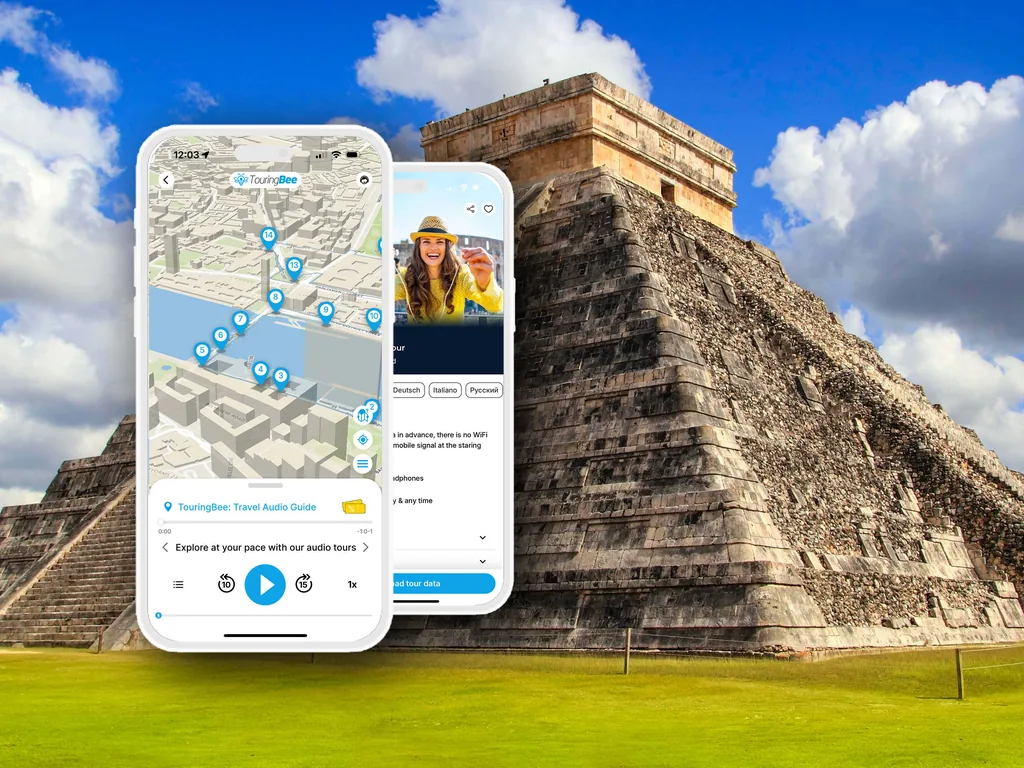
The TouringBee Chichén Itzá audio walk is 16 stops and about 90 minutes of narration, in walking order from the entrance to El Castillo and back. An offline GPS map shows where you are; you start each recording yourself when you reach the spot, so your eyes stay on the carvings rather than the screen. One payment, €9.99, works offline — which matters, because mobile signal inside the archaeological zone is poor — and it stays on your phone for a year.
Start from the fixed number everyone pays. Entry for a foreign adult is 697 MXN (about €35 / US$40), paid as one ticket at one window — the Boleto Único replaced the old two-counter system in spring 2026. The total still breaks down as the federal INAH fee of 105 MXN plus the Yucatán state fee of 592 MXN. Foreign children aged 3–12 pay 105 MXN. Mexican nationals pay around 300 MXN with ID. Card payment is available, but bring pesos in case the terminal is down. Buy entry in advance → — both government fees in one booking, settled before you arrive.
Organised group day tour from Cancún: roughly €55–75 per person for a standard coach tour, €85–110 for a small group, usually with entry, guide, transport and lunch included. Early-access tours that get you in before the main wave run US$35–100.
Licensed guide at the gate: 800–2,000 MXN per group, not per person, for 1.5–2 hours. A visitor in March 2026 reported being quoted 1,300 MXN. Split four ways that is around 325 MXN — €17 — each, on top of your entry.
Private tour: US$295–450+ for the vehicle and guide, or roughly €180–300 per person once you divide it up.
Independent by bus: ADO from Cancún is 400–500 MXN each way, about 2.5 hours, with a morning departure around 08:30 that puts you at the site near 11:00 — the same arrival time as the coaches, which is the flaw in this route. From Valladolid a colectivo is 100–150 MXN and 45 minutes, and it can have you at the gate at opening.
Independent by car: €30–45 a day for an economy car, €15–25 for the insurance you will be required to take, about 300 MXN in tolls each way on the 180D, €15–25 of fuel for the round trip, and 80–100 MXN to park. Split between three or four people it is the cheapest fast way to get there, and the only one that gives you full control of the clock. Compare car hire →
Audio guide: €9.99, once, for everyone travelling with you who wants it on their own phone.
So the honest arithmetic for two people from Valladolid, arriving at opening: 1,394 MXN of entry, 300 MXN of colectivo, €9.99 of audio guide — a bit under €90 for the pair. The same two people on a standard coach tour from Cancún: €110–150, with entry and lunch included, arriving three hours later.
The gap is smaller than people assume. The real difference is not the money. It is the time of day.
Here is the timetable that decides your visit.
The gates open at 8:00. Ticket booths stop selling at 16:00 and the site closes at 17:00. The first coaches from Cancún and the Riviera Maya reach the car park between 10:30 and 11:00.
That gives an independent visitor a two-and-a-half-hour window in which Chichén Itzá is a different place. The Great Ball Court is empty enough to test the echo. You can photograph El Castillo without a queue in the frame. The northern zone has almost no shade, and at eight in the morning that does not matter yet.
One more thing if you are driving yourself: crossing from Quintana Roo into the state of Yucatán puts your phone back an hour. You gain a morning. Plan around the local clock, not the one on the coast.
The counter-argument is real, though. Getting yourself to the gate for 8:00 means either sleeping in Valladolid the night before, or leaving the coast at 5:00 in the dark. Some people would rather have the coach and the extra sleep, and that is a legitimate trade, not a mistake.
On a coach tour you can change nothing. The bus leaves when the bus leaves. If the Sacred Cenote turns out to be the thing that grips you, you still get the eight minutes the schedule allows. If you want to sit in the shade for twenty minutes because the heat has caught up with you, you fall behind the group.
With a gate guide you can negotiate the route and the pace before you start, and a good guide will read you as you go. But you are still on a shared clock, and if you booked a coach and hired a guide inside it, you have two clocks.
Private tours are as flexible as you are willing to pay for.
Independent with audio is the only version where pause actually means pause. Stop the recording, drink water, sit in the colonnade for ten minutes, photograph the light on the Nunnery façade for as long as it is doing what you want, then pick up where you stopped. Families with children and anyone who wilts in heat feel this difference more than anyone.
"I liked that I could take breaks, sit in the shade, then keep going." Albert Parson · Tripadvisor
A guide standing in front of the Tzompantli can tell you which of the carved skulls is the one people always miss, and then answer the question you ask next. A recording cannot — that is the one thing a live human wins on every time. If you like asking questions, hire the human. That is the honest version.
What a recording does better is consistency and language. A gate guide might be excellent or might be a man reciting a script he learned in 2011. The audio walk tells every visitor the same researched story — how the Toltecs built El Castillo over an older Maya temple which was itself built over a water-filled sinkhole; why the ball court's acoustics carry 168 metres; what Edward Thompson actually pulled out of the Sacred Cenote when he dredged it. And it tells it in Russian, Polish or Portuguese, which almost no gate guide will.
The route is maintained. Archaeologists rope off one area and open another, the walking order changes with them, and the update reaches the app on its own — no repurchase.
The best combination, if your budget stretches, is not either/or: arrive at 8:00 independently, walk the audio route while the site is empty, and hire a gate guide for the last 45 minutes to ask everything the recording made you curious about.
Take the organised day tour if you are based on the coast without a car, you want the cenote and Valladolid handled for you, you do not want to think, and you are relaxed about arriving in the middle of the day.
Hire a guide at the gate if you learn by asking, you are travelling in a group of three or more so the flat fee splits well, and you speak Spanish or English.
Book a private tour if you are four or more, you value door-to-door service more than the money, or you have mobility needs that a coach schedule cannot accommodate.
Go independent with an audio guide if you want the 8:00 opening, you are travelling with children who need breaks, you want the commentary in a language the gate does not offer, you are on a budget, or you simply hate walking in a group behind a raised umbrella.
| Group day tour | Gate guide | Private tour | Independent + audio | |
|---|---|---|---|---|
| Cost (2 people) | €110–150 | Entry + 800–2,000 MXN per group | €360–600 | Entry + €9.99 |
| Arrival time | 10:30–11:00 | You choose | You choose | 8:00 possible |
| Time on site | ~2 h, fixed | 1.5–2 h guided | Flexible | Unlimited to 17:00 |
| Can you pause? | No | Partly | Yes | Yes |
| Ask questions | Yes | Yes, best | Yes | No |
| Languages | ES/EN mostly | ES/EN, some FR/DE/IT | On request | 8 including RU, PL, PT |
| Logistics handled | All | None | All | None |
| Best for | No car, no planning | Curious askers | Groups of 4+ | Early birds, families, budget |
We sell an audio guide, so read this with that in mind — and then notice that we are not telling you it wins every time.
If you have no car and no appetite for planning, take the coach tour. It is a fair product, the cenote-and-Valladolid combination is genuinely good, and the arithmetic is not far off doing it yourself once you count fuel and tolls.
If you want a person to talk to, hire a licensed guide at the gate and split the fee. For three or four people it is the best value on this page.
But if you can get yourself to the gate for 8:00 — and from Valladolid that is easy, a 45-minute colectivo — then go independently and carry the stories with you. That morning is the version of Chichén Itzá the coaches never see, and €9.99 is not the part of the day worth economising on.
Not necessary, but without one the site is mostly unexplained stone — the on-site signage is thin and not always in your language. Either hire a licensed guide at the entrance or bring a self-guided audio walk. Going in with nothing is the one choice we would argue against.
Licensed guides at the entrance charge 800–2,000 MXN per group for 1.5–2 hours, not per person. Agree the price and the duration before you start walking.
If you have no car, yes — it solves the whole day for €55–75. Accept that you will arrive around 11:00, in the heat and the crowds, and have about two hours on site.
Yes. Drive, take the ADO bus from Cancún or Mérida, or take a colectivo from Valladolid, then buy your ticket at the visitor centre on arrival. No advance booking is required for standard entry.
A guided tour gives you a person who answers questions on a shared schedule. An audio guide gives you the same route and stories at your own pace, in your own language, for a fraction of the price — but it cannot answer anything.
No. The audio guide is the commentary only, €9.99. Entry is paid separately at the gate: 697 MXN for a foreign adult in 2026.
Gate guides work mainly in Spanish and English; French, German and Italian are available with some searching. Russian, Polish and Portuguese are rare, which is the main reason travellers in those languages use an audio guide.
Two to three hours covers the archaeological zone at a comfortable pace. The audio walk is about 90 minutes of narration across 16 stops, leaving room for photographs and shade.
The pyramid, the ball court, the well and the observatory — explained where you're standing, at your own pace.
Get the Audio Tour — from €9.99